

By CMC
ST. JOHN’S, Antigua – The Antigua and Barbuda government used its overwhelming majority to pass a resolution allowing it to continue negotiations with the United States on receiving third-country nationals (TCN) even as the opposition maintained that St. John’s had no “cards” to affect the outcome of the US migration policy.
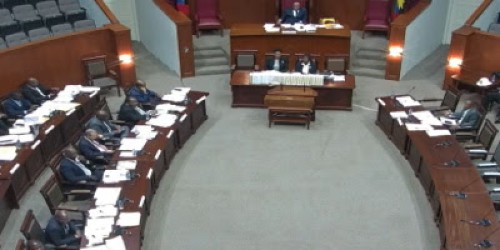
Antigua and Barbuda parliament debating resolution on third country citizens with Opposition Leader Jamale Pringle not present.
Prime Minister Gaston Browne, who tabled the resolution in Parliament on Tuesday, said that the country would rather face additional visa restrictions from Washington than accept third-country nationals with criminal backgrounds, whom he said would pose a far greater threat to the Caribbean island’s safety and development.
The resolution outlines the government’s negotiating principles for any agreement with the United States on the possible transfer of third-country nationals, with Browne telling legislators “if we were faced with an option of not taking criminals and to have visa restrictions, we’ll go for the visa restrictions because accepting criminals will destroy our country”.
But he noted that the “negotiations at this point do not indicate that Antigua and Barbuda is obliged to take any criminal elements” and that all formal exchanges with the United States have excluded such a requirement.
Browne said the disagreement arose because draft language submitted by the United States did not explicitly state that convicted criminals would be excluded from any transfer arrangement.
“We can then amend the language to state that we will not accept criminals, except individuals who may have been involved in visa violations,” Browne said, noting that Antigua and Barbuda has historically taken a practical approach to immigration offences by periodically granting amnesties to undocumented migrants, many of whom are Caribbean Community (CARICOM) nationals.
He said the government would be prepared to consider accepting individuals whose only offence was a visa violation, particularly if they possess skills needed in Antigua and Barbuda, including nurses, specialist doctors and skilled construction workers.
“What we don’t want are criminal elements. We don’t want any liabilities either,” Browne said, adding that the government also intends to reject individuals who are likely to become a financial burden on the country.
He said that Antigua and Barbuda will seek up to US$75,000 in financial support for each third-country national it may agree to receive, indicating that the country’s high cost of living requires greater assistance than other participating nations have reportedly received.
“My understanding is that they have given between US$25,000 and US$50,000 to some countries for each individual. I said to them Antigua and Barbuda is an expensive country, so we may want to consider about US$75,000 each.”
But in his contribution, Barbuda legislator, one of two opposition legislators in the Parliament, Trevor Walker, who abstained when the matter was put to a vote, said that the government is negotiating from a position of weakness with the United States. Opposition Leader Jamale Pringle was not present during the debate on Tuesday.
“I want Antiguans and Barbudans to hear me. Antigua and Barbuda don’t have no cards. You have no cards,” Walker said, acknowledging that while negotiations remain the appropriate course, he is also questioning what Antigua and Barbuda hoped to secure in return for cooperating with the United States.
“If that’s what the government is going to do, then what are the reciprocal arrangements that are being sought by Antigua and Barbuda?” he asked, adding that he did not believe the question was unreasonable.
Walker said the matter should not be approached as a partisan issue because any agreement would affect all citizens.
“This matter ought not to be partisan and political because it will affect all of us,” Walker said, noting that Antigua and Barbuda was negotiating while already subject to heightened US travel restrictions.
He said the government should explain why Antigua and Barbuda has reached what he described as one of its most difficult periods in relations with the United States.
“The Prime Minister of this country has an obligation … to let Antiguans and Barbudans understand why Antigua and Barbuda at this time is placed in a position where things are almost at the highest element of hardship when it comes to United States travel restrictions.”
Walker contrasted the current situation with Antigua and Barbuda’s relationship with the United States during the mid-2000s, when he said then-U.S. Secretary of State Condoleezza Rice commended the country for legislation promoting accountability and transparency.
Walker said whatever decision the government ultimately makes must protect Antigua and Barbuda’s economic interests, particularly tourism, while preserving citizens’ ability to travel, study and conduct business in the United States.
“Our access to the United States, to do business, to go to school … and also the whole question of our economic survival, which is tourism, all those things must be taken into consideration,” he said.
Foreign Affairs Minister E.P. Chet Greene defended the government’s negotiations with the United States, saying Antigua and Barbuda engaged Washington to protect its sovereignty rather than surrender it.
“We engage because responsible governments do. They do not make important decisions in ignorance. They do not refuse to listen before they know what is being proposed. And they do not confuse engagement with agreement.”
He said the issue extended far beyond immigration policy, describing it as a test of how a small independent state responds when a powerful ally presents proposals that raise questions about sovereignty, national security and the country’s future.
“This debate is not simply about immigration. Neither is it about the United States of America. It’s about something fundamentally much bigger. It’s about how Antigua and Barbuda, as a small independent nation, responds when a close and powerful neighbour and friend asks something that raises serious questions for our own sovereignty, our laws, our security and our future,” Greene said.
He urged legislators to treat the matter as a national issue rather than a partisan one, arguing that questions involving sovereignty and foreign policy transcend political parties.
“When questions arise that touch the sovereignty of our country, our immigration policy, international obligations and the welfare of our people, our first duty is not to any political party. It must be to Antigua and Barbuda.”
Greene said that Antigua and Barbuda remained a sovereign nation regardless of its size and rejected any suggestion that the country had compromised its independence through negotiations.
“We are a sovereign nation. Small in size, equal in dignity. Our flag carries the same worth and legal standing in the community of nations as does the flag of any larger state,” he said, even as he acknowledged the realities facing small states.
“The responsibility of government is not to complain about that reality. It is to navigate it wisely. That means protecting our sovereignty without isolating ourselves, maintaining our friendships without compromising our principles, working with our partners without surrendering our judgment,” Greene said, dismissing criticism that the government should have publicly dismissed the US proposal from the outset.
“Leadership is not measured by how loudly a government speaks. It is measured by how well it protects the interests of its people.
“We listened, we examined every proposal, we took legal advice, we consulted officials, we assessed the implications, and when we concluded that important parts of the proposal were not in Antigua and Barbuda’s best interest, we simply rejected them,” he added.
Meanwhile, Attorney General Sir Steadroy Benjamin said that Antigua and Barbuda has not entered into a final agreement with the United States on the transfer of third-country nationals, insisting that negotiations are still underway.
Benjamin rejected suggestions that Parliament was being asked to endorse a completed agreement, saying no such document currently exists.
“The White Paper is not presented as a complete agreement, nor is this House being asked to approve a conclusive operating agreement. None exists,” Benjamin said, explaining that the resolution seeks parliamentary approval of a framework that would define the government’s negotiating position while allowing Cabinet to continue discussions with U.S. officials.
“The role of this Parliament is to determine the governing principles and the limits within which the Executive may proceed. Negotiation is, by its nature, an executive function,” Benjamin said, adding that once Parliament establishes those principles, the Executive will negotiate within the boundaries set by lawmakers and return with any necessary legislation if a final agreement requires changes to domestic law.
Tourism Minister Charles Fernandez said Antigua and Barbuda must carefully balance protecting its national interests with maintaining a strong relationship with the United States, warning that a breakdown in negotiations could have serious consequences for the country’s tourism-dependent economy.
“The point I’m making is yes, might is right,” Fernandez told lawmakers, arguing that Antigua and Barbuda must pursue a practical approach while defending its national interests.
Fernandez said tourism accounts for approximately 60 to 65 per cent of the country’s gross domestic product, making it essential that the government avoid actions that could jeopardise the industry.
“If we lose our tourism, 60, 65 per cent of GDP (would go) down the drain,” he said, adding that the impact would extend beyond hotels, affecting thousands of workers employed throughout the industry, including restaurant staff, tour operators and others whose livelihoods depend on visitor arrivals.
He said the government therefore could not simply reject negotiations outright nor accept every proposal presented by Washington.
“So it is a balancing act. We have tried to strike a balance whereby we can stand up and say with dignity and pride, this is what we obtained, this is what we asked you to put into the agreement, and that is what we’re looking for,” Fernandez said.