
OECS Press Release
Across the Eastern Caribbean, the persistent arrival of sargassum seaweed has long presented a critical challenge to coastal communities, marine ecosystems, and local economies. However, insights gained from a comprehensive study tour through Martinique and Guadeloupe are now driving a transformed, solution-oriented response across Organisation of Eastern Caribbean States (OECS) Member States.
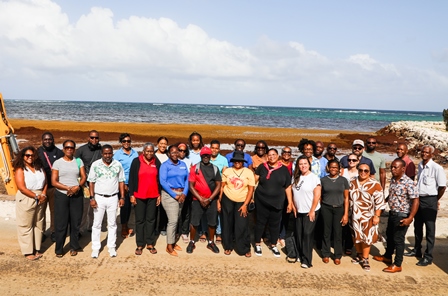
Supported by the European Union’s 11th EDF RIGHT Programme and the SARSEA project, a delegation of technical experts and policymakers representing nine OECS Member States undertook a strategic mission (June 1-5) to examine advanced management and valorisation models. By observing operations in the French Caribbean Outermost Regions, the initiative aimed to bridge technical innovation with regional policy, turning a shared ecological threat into a vital pillar of the Caribbean blue economy.

Emphasising the shared regional challenge and the power of collaborative solutions, Susana Agüero, Programme Manager at the Delegation of the European Union to Barbados, the Eastern Caribbean States, the OECS, and CARICOM/CARIFORUM, highlighted the significance of the partnership:
“Martinique is one of the French regions tackling the very same issues affecting economies, public health, and tourism across the wider Caribbean and OECS Member States. We are learning directly from their experience. They have built an integrated network using multiple approaches — from manual collection to specialised sea barriers and offshore harvesting. Furthermore, ongoing developments in storage and processing will soon convert sargassum into valuable commercial products, simultaneously protecting vulnerable sectors and community health.”
The urgency of implementing these tested solutions is evident across the region, where decaying seaweed along shorelines, such as in the fishing village of Soubise, Grenada, releases toxic gases and disrupts daily life. Beyond immediate coastal disruption, decaying sargassum degrades vital mangroves and coral reefs, accelerates coastal erosion, and severely impacts small-scale fishers by damaging equipment and restricting access to fishing grounds. Addressing these multi-faceted challenges requires the coordinated, inter-agency approach demonstrated during the mission.

A primary focus for the OECS is valorisation, converting raw sargassum into commercially viable resources. At the Holdex facility in Le François, Martinique, participants observed functional models for composting and bioenergy production, demonstrating how processed sargassum can enhance agricultural yields by up to 14 per cent or supply cost-effective biogas for energy needs.
Reflecting on these operational takeaways, during a roundtable with local authorities in Marie-Galante, Natasha Deterville-Moise, Officer-in-Charge of the OECS Economic Development Unit, noted:

“These operational insights will directly inform the development of robust regional mitigation and adaptation plans. By fostering active collaboration between public and private stakeholders, the OECS Commission is positioning the proven solutions in the French Territories as a practical framework for building a more resilient and sustainable Eastern Caribbean.”
Throughout the tour, delegates examined every stage of the sargassum management cycle:
Offshore Interception & Coastal Protection: Reviewing protective barriers and specialised barges in Martinique designed to capture seaweed before it reaches delicate shorelines.
Environmentally Sensitive Collection: Visiting sites at Macabou and Pointe Faula. Dr Hardin Jn. Pierre, representing Saint Lucia’s Ministry of Agriculture, noted that observing manual collection was particularly instructive, as it highlighted methods to avoid heavy machinery that can compact beach sand and disrupt critical sea turtle nesting habitats.
Air Quality & Public Health Monitoring: Partnering with Madininair in Martinique and Gwad’air in Guadeloupe to review early-warning monitoring systems that provide data-driven health alerts to coastal populations.
Frontline Safety Protocols: Miklembly Bridgeman from Grenada’s Ministry of Tourism highlighted the value of personal gas monitors used during field operations, noting that implementing similar safety protocols across the OECS will be essential for safeguarding response teams.
By translating these field-tested practices, institutional frameworks, and public-private partnerships into actionable regional policy, the OECS Commission continues to advance a sustainable, climate-resilient future for coastal communities across the Eastern Caribbean.