

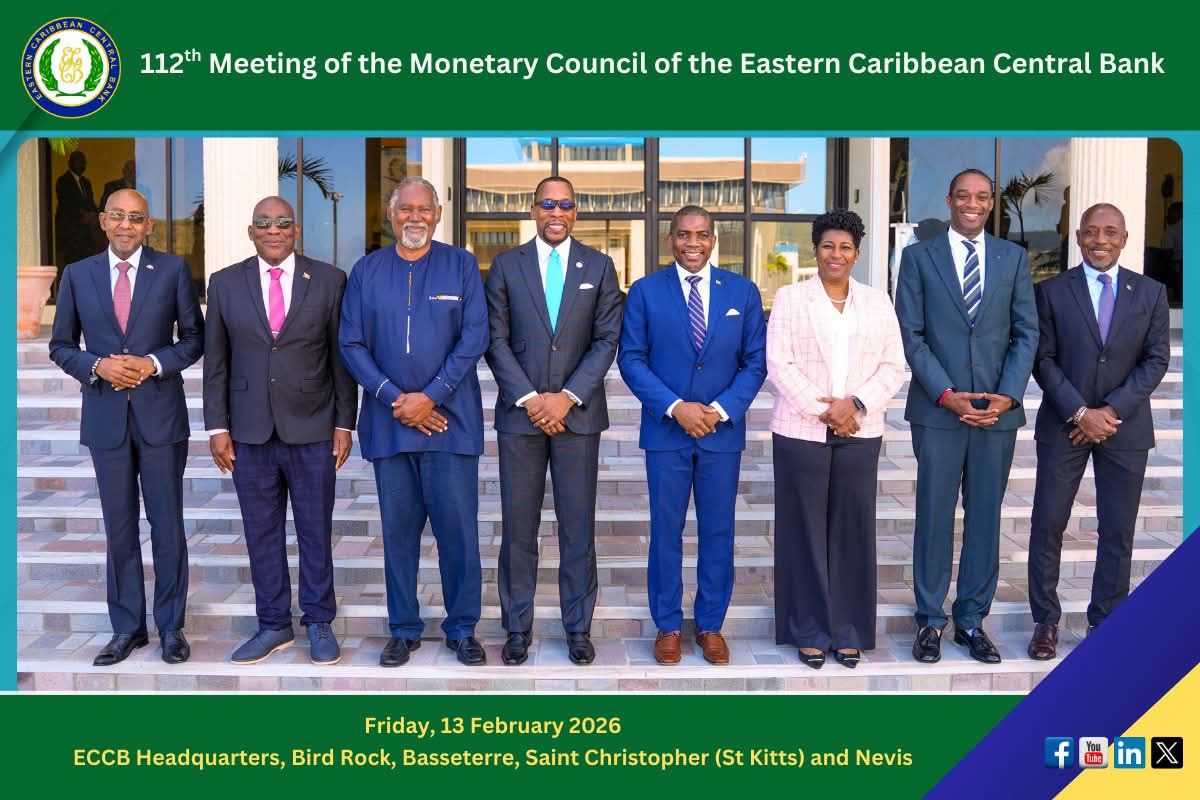
Source : Erasmus Williams
BASSETERRE, ST. KITTS — The Monetary Council of the Eastern Caribbean Central Bank (ECCB) convened its One Hundred and Twelfth (112th) Meeting on February 13, 2026, at the ECCB Campus in St. Kitts and Nevis, against a backdrop of evolving global dynamics, shifting geopolitical conditions, and persistent structural challenges within the Eastern Caribbean Currency Union (ECCU).
The deliberations, held under the chairmanship of Prime Minister Hon. Gaston Browne of Antigua and Barbuda, focused on safeguarding monetary and financial stability while accelerating structural transformation under the region’s Big Push for Shared Prosperity and Resilience.
The Monetary Council confirmed the reappointment of Mr Timothy N.J. Antoine as Governor of the ECCB for a term of five (5) years, effective February 1, 2026.
The Council underscored the importance of leadership continuity at a time when the region must pursue bold and coordinated policy actions to maintain stability and secure durable growth, diversification, and resilience.
Members reviewed the Governor’s Report on monetary, credit, and financial conditions in the Eastern Caribbean Currency Union, titled: “ECCU 2026 and Beyond: Bold Policies for Bigger and More Resilient Economies.”
The Council reaffirmed that monetary and financial stability remain the bedrock of the ECCU’s development strategy. The EC dollar remains strong and credible, with the backing ratio standing at 99.5 per cent — well above the statutory minimum of 60.0 per cent.
July 2026 will mark the 50th anniversary of the EC dollar peg at EC$2.70 to US$1.00.
In light of stable domestic conditions and moderating global inflation, the Council agreed to:
Maintain the Minimum Savings Rate at 2.0 per cent; and
Maintain the Discount Rate at 3.0 per cent (short-term) and 4.5 per cent (long-term).
The Council reaffirmed that the stability of the currency union remains non-negotiable and central to investor confidence and regional prosperity.
Global growth is projected at 3.3 per cent in 2026 and 3.2 per cent in 2027, supported by technological investment and easing inflationary pressures. However, risks remain elevated due to geopolitical tensions, shifting international trade and policy regimes, commodity price volatility, and uncertainty surrounding global mobility and financial flows.
The Council emphasized the need for policy agility and strategic partnerships to mitigate external vulnerabilities.
The ECCU banking sector remains stable and highly liquid, supported by strong capital buffers, a rising capital adequacy ratio, and a declining non-performing loans (NPL) ratio. Excess liquidity was estimated at EC$1.41 billion as at the end of January 2026.
The ECCU Credit Bureau continues to expand its reach. Five member countries — Antigua and Barbuda, Grenada, Saint Christopher (St. Kitts) and Nevis, Saint Lucia, and Saint Vincent and the Grenadines — are now live on the credit bureau system.
The Council also endorsed continued efforts to channel liquidity toward productive investment, particularly small and medium-sized enterprises (SMEs) and priority sectors under the Big Push framework.