

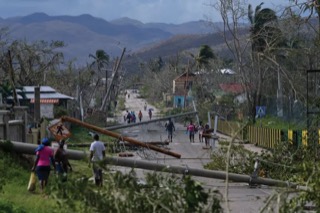
Source: Daily Campus
Hurricane Melissa tore through the Caribbean last week, leaving a trail of devastation that has stunned communities and scientists alike. The category five storm — the strongest ever recorded to make landfall in Jamaica — caused massive flooding, deadly landslides and widespread power outages across the region.
According to Project HOPE, the hurricane brought “catastrophic flooding and landslides” that damaged hospitals, homes and critical infrastructure. More than 75% of Jamaica lost power, and thousands of families have been displaced. UNICEF estimates that over 700,000 children across the Caribbean have been affected; many are now struggling with disrupted access to safe water, education and healthcare.
“Families are trapped in submerged neighbourhoods without power or remain in shelters, and access to clean water and sanitation is critically compromised,” UNICEF said in a press release. “Children urgently need food, safe drinking water and sanitation, access to health and nutrition services and a path back to education.”
University of Connecticut Department of Earth Sciences Associate Professor-in-Residence Tammo Reichgelt explained that Melissa’s record-breaking strength came from a combination of environmental factors and a concerning trend of warmer ocean waters.
“The basic ingredients for tropical storm formation and strengthening are relatively high sea surface temperatures, absence of wind-shear (meaning not a large difference between low and high-altitude winds) and high surface air temperature and humidity to sustain convection (sustaining a self-strengthening feedback system),” he said. “Melissa, however, was certainly very unusual in the extremely slow pace at which it moved. It also apparently had one of the lowest recorded minimum air pressures ever recorded for a hurricane at landfall, probably because it lingered so much right before making landfall.”
Normally, hurricanes weaken when they churn up cooler water from below the ocean’s surface. However, Reichgelt said the Caribbean waters beneath Melissa stayed warm, even at deeper levels, allowing the storm to continue strengthening.
“The churning of the hurricane into deeper, cooler waters, which didn’t break the feedback loop, is quite unusual. I, for one, hadn’t heard of that before,” he said.
Melissa also took an unexpected path, approaching Jamaica from the south instead of the typical east-to-west direction. Many communities were unprepared for the storm to strike at full strength.
“More than 13,000 people remained crowded into shelters, with 72% of the island without power and only 35% of mobile phone sites in operation,” according to NPR.
“Ocean waters above a certain temperature are what drives hurricane convection, so the longer it lingers over such ocean waters, the stronger it becomes,” Reichgelt explained. “The amount of rainfall that can fall as a result of this sometimes rivals the amount of rainfall that a single location receives in a year. This completely overwhelms the natural and infrastructural capacity for draining away that water.”
Scientists say Hurricane Melissa reflects a growing pattern of more intense storms in a warming climate.
“One of the basic ingredients for hurricane formation and strengthening is high sea surface temperatures,” Reichgelt said. “Increase the temperature and you can get stronger hurricanes, a longer hurricane season, and a larger moisture content of the individual hurricane.”
Relief groups like Project HOPE and UNICEF are now working to provide emergency medical care, food and clean water to affected families. But Reichgelt said long-term investment in disaster preparedness and climate adaptation will be crucial to prevent similar devastation in the future.
“The only thing that can be done is preparation, for example by infrastructural upkeep, making sure the communication is not vulnerable to breaking down, evacuations, emergency centers in every community, and making sure that there is a way to get fresh water, medicine, and food into communities that have been affected by the storm, since the breakdown of the regular infrastructure might mean that the traditional ways that people get these things are not operational anymore,” Reichgelt said. “All of that is expensive and thus affects nations with fewer economic means more severely.”