
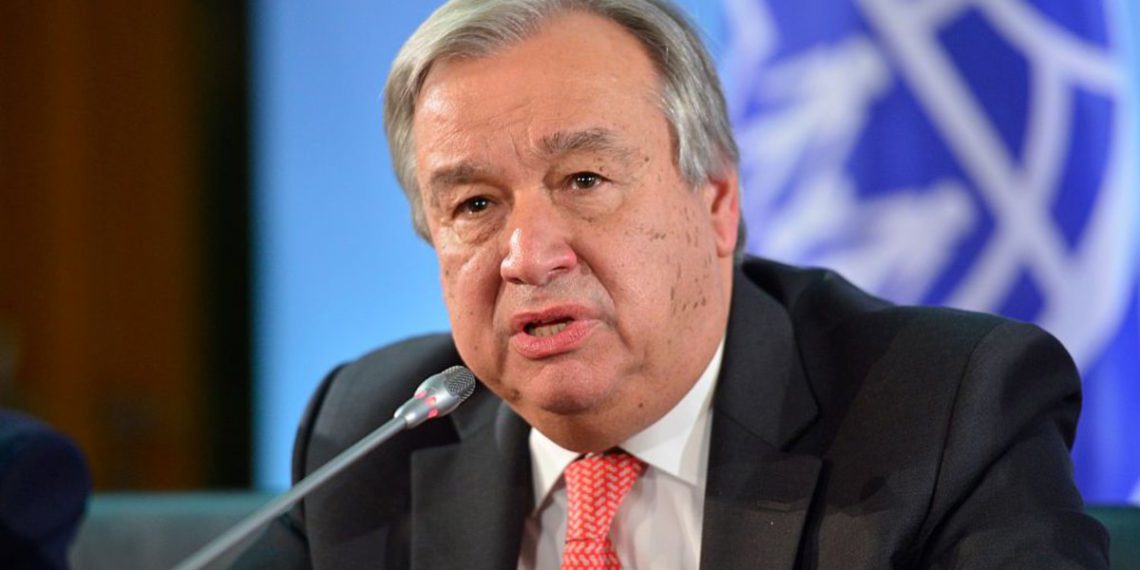
This is my final year as United Nations Secretary-General.
I intend to make every day of 2026 count. I am fully committed and fully determined to keep fighting and to keep pushing for the better world we know is possible.
In a world marked by conflict, impunity, inequality, and unpredictability, we cannot afford complacency, denial, or delay. We cannot be bystanders to injustice, indifference, or abuse of power.
We have the power to chart a different course.
As we find our bearings in these disorienting times, three principles must form the foundation of all our actions.
First, we must adhere to the United Nations Charter—fully and faithfully.
The Charter is a binding compact that unites us all. It is the foundation of international relations and the bedrock of peace, sustainable development, and human rights.
When leaders trample international law or selectively choose which rules to follow, they are not only undermining global order—they are setting a dangerous precedent.
Second, we must confront the growing concentration of power and wealth.
Increasingly, we see a world in which the ultra-wealthy and the corporations they control exert unprecedented influence.
When a handful of individuals can shape global narratives, sway elections, or dictate the terms of public debate, we are not merely facing inequality—we are witnessing the corruption of institutions and the erosion of shared values.
Nowhere is this clearer than in artificial intelligence and the algorithms shaping our lives. These technologies are too consequential to be controlled by a few companies or optimised solely to monetise attention and outrage.
Humanity must guide technology, not the other way around.
The concentration of power and wealth in so few hands is morally indefensible. More than that, it poses a clear and present danger to the Charter and to the promise of equal rights and dignity for all.
Third, we must be relentless in our pursuit of peace with justice—peace among nations and peace with nature.
Conflicts have trapped millions of people in prolonged cycles of violence, hunger, and displacement. This suffering cannot continue.
Peace with justice means peace rooted in international law and human rights—economic, social, cultural, civil, and political—which are inalienable, indivisible, and interdependent.
We must also open doors of opportunity for women and girls everywhere. Let me be clear: we cannot and will not yield to the disturbing backlash against women’s rights—rights belonging to half of humanity—or to the erosion of hard-won gains in equality, participation, and protection.
I am proud that, for the first time in UN history, we achieved gender parity at senior levels. We are stronger because of it, and we will continue to move forward.
Peace with nature is equally essential. A world in climate chaos cannot be a world at peace.
Climate change is a threat multiplier—intensifying competition over land, water, and food; forcing people from their homes; and destroying the ecosystems on which we all depend.
It is also a profound injustice that those least responsible are suffering first and worst.
Climate justice is an investment in peace and security, because vulnerability anywhere becomes a risk everywhere—reverberating through financial systems, supply chains, and global stability.
All of this is vital to building a more equitable, peaceful, just, and sustainable future.
We must build unity in an age of division.
Across the world, societies risk fracturing under the weight of racism, xenophobic nationalism, and religious bigotry. These dangers are not abstract; they are visible in the daily lives of millions, fueled by rhetoric and disinformation designed to exclude rather than unite.
It is not enough to denounce these forces or simply say, “This is wrong.”
Our challenge—and our responsibility—is to build inclusive societies where every identity is respected, where all people feel they belong, and where shared civic values bind us together.
Harmony is never accidental. It requires deliberate policy, resources, and political courage.
If we fail to put our common humanity first, we risk losing everything that makes us strong.
The choice is clear: inclusion or isolation, renewal or decline.
The Charter is our compass. Peace with justice is our purpose. And our shared humanity is our imperative to act.
The world is changing—often in unsettling ways, but also in inspiring ones. The forces of division and inequality are powerful, but so too is our capacity for solidarity and justice.
Even amid today’s rough seas, we can anchor our actions in peace, dignity, and hope.
That requires the best efforts of everyone.
Let us never give up.